Introduction
to the Jews that contributed to the building of South
Africa and
the prosperity
of Johannesburg.
The
story of the Jews connection to the continent of Africa began
way back in the 14th century when robust maritime and seafaring
activities brought about the creation of the first map, created
by a Jew, which plotted the initial 2000km of the African coastline.
The work of another famous Jewish astronomer developed the first
instruments of navigation used by the Portuguese explorers who
navigated the route around the African continent, establishing
the sea route to India. Among those on board these expeditions
was a Jew who served as an interpreter, speaking Hebrew and
Arabic, who was able to communicate with tribes settled along
the African coastline, and most likely the first Jew ever to
go ashore on the tip of Africa.
 |
The
first settlement at the Cape was of Dutch decent, established
by Jan Van Riebeeck in 1652, a representative of the multinational
Dutch East India Company, whose restrictive laws stated that
all employees of the company had to be of Protestant Christian
denomination. This left very little opportunity for Jews, Catholics
or any other religion for that matter, to flourish in this fledgling
society. For the next 143 years of Dutch domination in the Cape
Colony, Jews working for the company were either converted out
of their religion of origin or non-professing. It is strange
to note however, that the company went on to acquire a Jewish
Chairman back in Holland, where Jews were eventually allowed
to invest and become more active in company affairs, due to
their growing financial standing and influence in European society.
1795
brought the arrival of the British to the colony as a result
of Napoleon & the wars that ensued and the Cape Colony went
back and forth under British and Batavian rule for a period
of 11 years until in 1806 it reverted to permanent British rule
where more religious freedom was granted according to the more
tolerant Victorian-British ethos of the time. Jews began arriving
in small numbers and began participating in the activities of
the growing community. Moneylenders, doctors, lawyers &
traders were among the first few to take part.
|
Now
a British Colony, attempts were put in motion to bring more
English involvement to this largely Dutch speaking colony and
so in 1820, British settlers were brought in to make up the
numbers, and settled in the Cape Colony, many in the eastern
regions under harsh conditions. Approximately 18 of these '1820
settlers' were Jewish, of which a few came to be instrumental
in establishing the first organized Jewish congregation of Cape
Town from 1841 onwards.
Clashes
between the British & Dutch (Boer) settlers in the Cape
Colony saw large numbers of Boers leaving in 1835 and 'trekking'
off into the great unknown to take up residence in different
parts of the interior, which they considered (falsely) to be
'open' territory for the taking, where most established farms
where they could continue with their preferred agrarian existence,
but battles over territorial issues with native tribes ensued
all along the way.
Jews
were among the first major merchant capitalists and big-time
entrepreneurs in the mid 19th century, establishing trading
networks in the interior, developing the country's first wool
markets with international reach, cold storage plants, shipping
industries and financing enterprises which propelled the country's
transition from a subsistence to a cash economy and the issuing
of the country's first bank note.
1867 saw the discovery of the first diamond on the banks of
the Orange River in disputed territory, which eventually became
absorbed into the Cape Colony and the town of Kimberley became
the hot-spot of attention from around 1870, when the diamond-rush
began. This was South Africa's first thrust towards industrial
and financial independence and prosperity. Along with the numerous
arrivals to the area came many of the Jews that contributed
greatly to the success of the diamond fields of Kimberley &
later on, the gold fields of the Witwatersrand in the Transvaal,
the territory east of the Cape Colony where the Boers were in
control under the watchful eye of the formidable President Paul
Kruger from 1882.
|
Jews
were amongst the most successful diamond magnets of Kimberley,
many of them acquiring much of the land around the gold strikes
in the Witwatersrand (with money made on the diamond fields) after
the 1886 discovery of the abundant Witwatersrand main reef, still
being worked today after 125 years and showing no signs of exhaustion.
This discovery founded the most prosperous big city on the African
continent and Jews were involved in its development and success
right from the very start.
From
the first great industrialist and wealthy mining magnates (The
Randlords), property developers, professionals, artists and
entertainers, traders, religious leaders, community builders,
retailers and soldiers…… the Jews contributed greatly
in all spheres of South Africa's development & prosperity.
They came mainly from England, Germany and the oppressed east
European countries, establishing a lasting legacy, still very
much part of the fabric of today's South African landscape.
Discover
who ALL these fascinating characters were, what they did and
how they contributed to the building of the South Africa of
today!
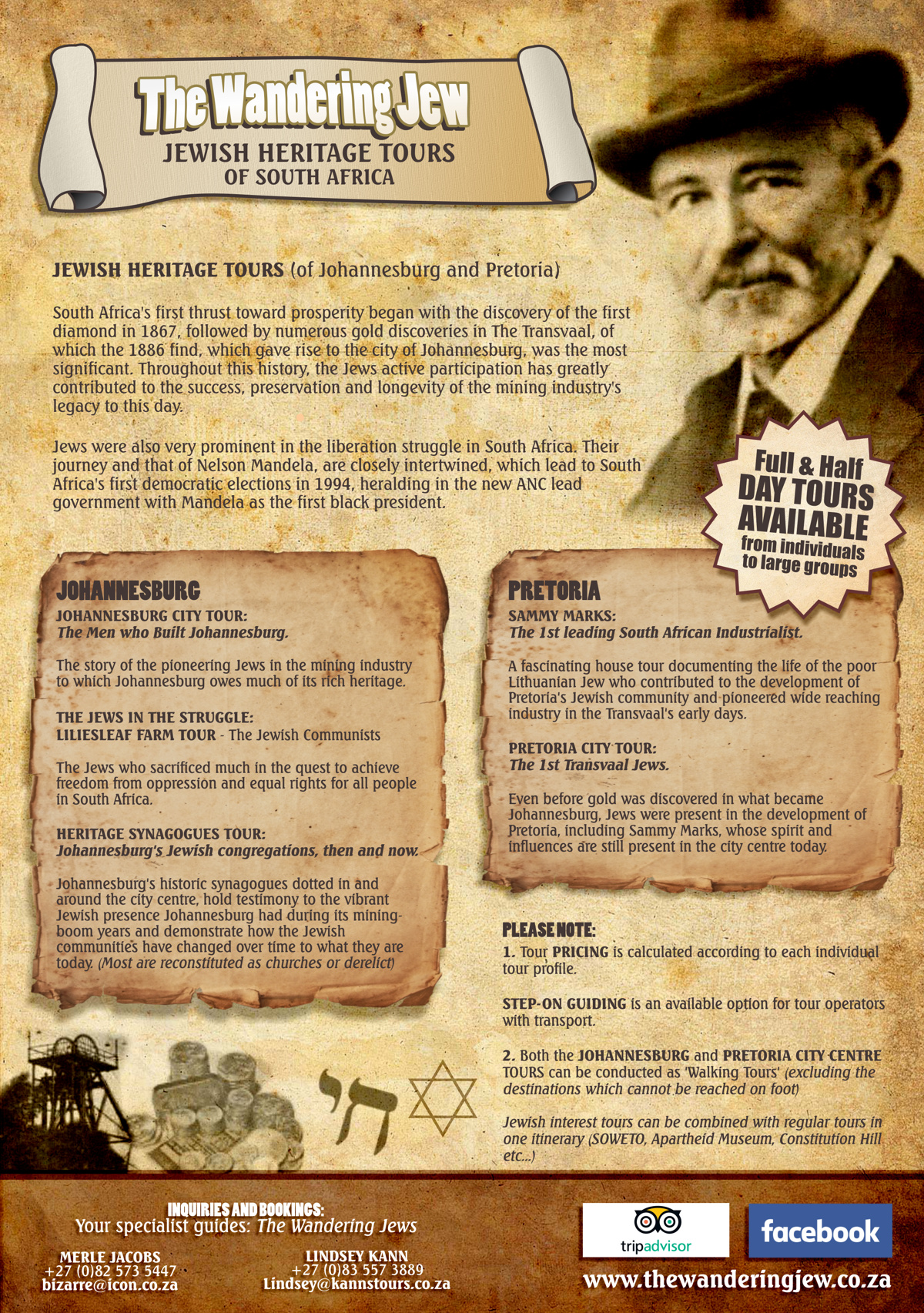
THE
WANDERING JEW heritage tours of Johannesburg will inform you
of everything you never knew about these remarkable people of
Jewish decent!
|
.jpg)